1 min read
Most analytical tests are named for what they measure. ATNC is named for what it estimates instead. It stands for Apparent Total Nitrosamine Content. The word "apparent" is there because the result covers nitrosamines already present in a sample, plus nitrite and nitrate, which go on to generate the nitrosating agents that form more.
Why "apparent" is in the name
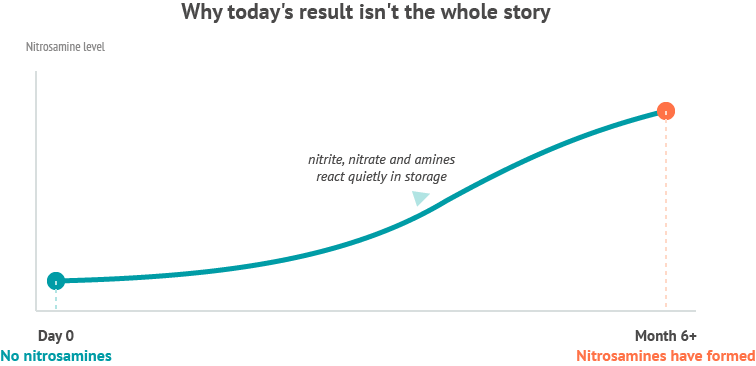
Nitrosamines don't always arrive in a product ready-formed. Many build up slowly: nitrite reacts with amines already sitting in an ingredient, and nitrate does the same once it has converted to nitrite. That reaction can carry on quietly in storage long after a product has left the factory. A cream or tablet can pass a nitrosamine test on the day it's made and still develop more of the compound months later, once the ingredients have had time to react.
This is the problem ATNC is built to solve. Rather than only counting nitrosamines that have already formed, the standard reaction also responds to nitrite and nitrate, the precursors capable of forming more. Both signals come back combined, as a single total, which is exactly why the method is called Apparent Total Nitrosamine Content rather than simply Total Nitrosamine Content. The result estimates what the product could still become, beyond what's measurable on the day of testing.
For most samples, that's the whole point of running the test. Cosmetics manufacturers work to a 50 µg/kg limit under EU Cosmetics Regulation (EC) 1223/2009, and ATNC, rather than other total nitrosamine methods, is the recognised technique for meeting it. Pharmaceutical teams use the same logic ahead of targeted analysis under ICH M7. In both cases, a result reflecting only today's chemistry would miss exactly the risk regulators are trying to catch.
Occasionally, a sample has enough nitrite or nitrate in it that the combined figure becomes difficult to read on its own. For those cases, Ellutia has developed a separate confirmatory method that removes the nitrite and nitrate contribution and reports a nitrosamine-only figure alongside the standard ATNC result.
How the test works
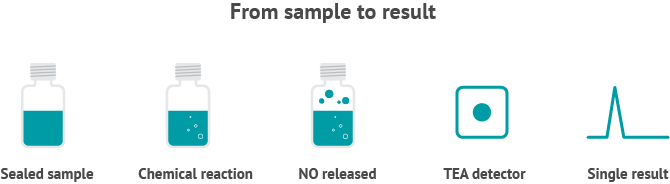
ATNC relies on a chemical reaction rather than a comparison against a library of known compounds. Sealing and heating a sample releases NO, the nitric oxide group, from any nitrosamines, nitrite and nitrate present in it. That's why the standard result includes all three.. That gas passes into the TEA, Ellutia's Thermal Energy Analyser and the detector technology built for nitrosamine detection. It responds only to NO and ignores everything else in the sample, so background from the rest of the matrix doesn't interfere with the reading. The output is a single number, reported in parts per billion, reflecting everything nitrosamine-related in the sample rather than one compound at a time.
Because the reaction responds to the group as a whole, the test doesn't need a reference standard for every possible nitrosamine. A lab investigating a new formulation, ingredient, or supplier often doesn't know in advance which compound, if any, is worth worrying about. ATNC doesn't require that knowledge upfront. It just asks whether nitrosamine formation is happening in this sample at all.
Where ATNC is used
Because cosmetics has had a specific regulatory limit for years, it's the industry ATNC gets talked about most. But the same testing applies well beyond cosmetics. Pharmaceutical manufacturers use it ahead of ICH M7 screening. Rubber and elastomer producers use it on products like teats and soothers, where nitrosamines can migrate out of the rubber itself. Food producers run it on ingredients like malt, since something that looks fine today can still be a problem once it's had time to react.
What comes next if a result is high
ATNC is deliberately a screening result rather than a full breakdown. That's exactly right when the only question is whether a risk exists at all. But once a result comes back above the relevant limit for an industry, a manufacturer usually wants more detail than one combined number can give.
There are two ways to get it. GC-TEA separates and identifies individual compounds, so a sample that needs checking specifically for something like NDMA or NDEA goes through GC-TEA instead. And because the standard ATNC figure includes nitrite and nitrate alongside the nitrosamines themselves, the confirmatory method mentioned earlier can also be used here, stripping out the precursor contribution to leave a nitrosamine-only number. Which route makes the most sense depends on what's actually driving the result, an unknown compound or a genuine precursor load.
ATNC Testing
A single ATNC result looks forward rather than just at today. It tells a manufacturer what a product is likely to contain months from now, while it's still possible to do something about it. That's a real advantage over waiting for a regulator, or a customer, to find out first.
Ellutia runs ATNC testing in-house on the TEA, the technology built for nitrosamine detection, already trusted by pharmaceutical and cosmetics manufacturers. Send a sample and get a result back within 7 days, no instrument purchase required.
1 min read
Benefits of a Nitrosamine Selective Detector
Nitrosamines, such as N-Nitrosodimethylamine (NDMA), are carcinogenic compounds that can form during the drug manufacturing process and storage under...
1 min read
NDMA Contamination in Metformin: Detection, Risks, and Best Practices
The issue of NDMA contamination in pharmaceuticals like metformin has become an industry-wide focus due to its implications for patient safety and...