1 min read
Ensuring Quality Control: Testing in Beer Production
Discover the essential role of testing in beer production and how it ensures quality control throughout the process. Testing plays a crucial role in...

6 min read
Ellutia Jun 16, 2026
Nitrosamines have been a known concern in cosmetics for decades. The science linking them to carcinogenic risk is well established, the regulations prohibiting them are in place, and most manufacturers operating in the EU and UK are aware they have obligations around them.
Awareness is rarely the issue. Knowing you need to control nitrosamines and having a reliable way to do it are two different things. For a lot of cosmetics manufacturers, testing has meant sending samples to an external lab, waiting for results, and hoping nothing comes back positive. That approach is increasingly difficult to defend as regulatory scrutiny tightens and the expectation shifts from reactive testing to proactive control.
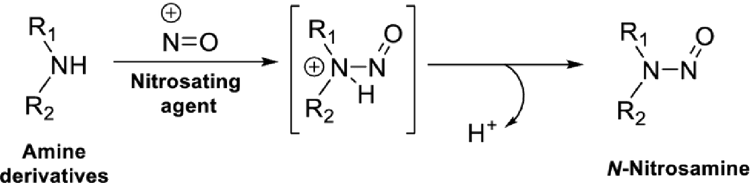
Nitrosamines are a family of chemical compounds formed when secondary amines react with nitrosating agents. Neither component is unusual in cosmetics. Secondary amines such as diethanolamine (DEA) and triethanolamine (TEA) are widely used as pH adjusters, emulsifiers, and wetting agents. Nitrosating agents can be present as impurities in raw materials, or can form gradually during manufacturing and storage. Some preservatives, including bronopol and certain nitrite-releasing compounds, are known to act as nitrosating agents when combined with amine-containing ingredients.
The nitrosamine formation reaction: amine derivatives and a nitrosating agent combine to produce an N-nitrosamine.
The result is that nitrosamines can appear in a finished product as an unintended consequence of ingredient chemistry rather than any failure in manufacturing. They are difficult to predict purely from looking at an ingredient list, and they can form or increase in concentration even after the product has left the factory. Hair care products, lotions, and shampoos have historically shown the highest rates of nitrosamine detection, though the risk exists across product categories wherever amine-containing ingredients and nitrosating agents are present in the same formulation.
Several nitrosamines, including NDMA and NDELA, are classified as category 1B carcinogens under EU classification. NDELA in particular is the most commonly detected nitrosamine in cosmetics, most often found in products containing DEA or TEA in combination with certain preservatives. The concern is not acute toxicity but long-term exposure risk, which is precisely why regulators treat even trace levels seriously.
Nitrosamines are prohibited substances under EU Cosmetics Regulation EC No 1223/2009. The regulation sets a maximum nitrosamine content of 50 μg/kg in cosmetic ingredients, and requires that high-risk precursor ingredients are not used in combination with nitrosating agents and are stored in nitrite-free containers.
That limit has been in place for some time. What has changed is the enforcement context around it. Regulatory bodies are paying closer attention to how manufacturers are demonstrating compliance, not just whether their finished products meet the limit, but whether they have a testing process in place that would reliably catch a problem before a product reaches the market.
The UK deadline of 6 July 2026 is a useful example of where this is heading. It marks the end of the sell-through period for cosmetic products containing Methyl-N-methylanthranilate (M-N-MA) above permitted limits. That ingredient is a secondary amine with the potential to form nitrosamines, and its restriction under UK cosmetics regulation reflects the same logic that underpins the broader nitrosamine prohibition: where formation risk exists, manufacturers are expected to control it and demonstrate that control.
For manufacturers selling in both the UK and EU, it is worth noting that the EU has operated equivalent restrictions for longer. The direction in both markets is the same.
Knowing nitrosamines are a risk and being able to reliably detect them are not the same thing, and this is where a lot of manufacturers get stuck.
The obvious approach is to test for the nitrosamines you know about. NDMA, NDELA, and a handful of others are well documented, and methods exist for measuring them. But there are dozens of known nitrosamines, and testing for a fixed list means you are only ever checking for the ones someone thought to put on the list. If your formulation produces a nitrosamine that is not on it, compound-specific testing will not find it.
But what happens when your formulation produces a nitrosamine that nobody put on the list? It is not a hypothetical. New nitrosamines are identified in cosmetic products on a fairly regular basis, often in product categories where nobody was looking for them. A fixed list of named compounds cannot catch something nobody knew to look for, and that tends to stay invisible right up until something goes wrong.
The alternative is to test for total nitrosamine content rather than working through a list of named compounds one at a time. That is the logic behind ATNC analysis, and it is why it has become the recognised approach for cosmetics specifically.
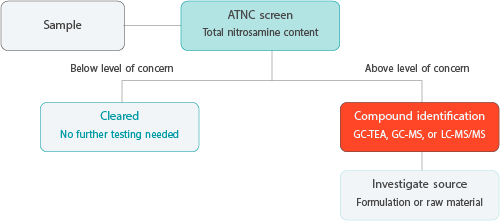
ATNC stands for Apparent Total Nitrosamine Content. Rather than testing for a specific named nitrosamine, it measures the total nitrosamine content of a sample in one result. If that total comes back below the level of concern, you have your answer: no individual nitrosamine in the sample can exceed that total either, so the product is clear.
If the ATNC result comes back positive, that is not the end of the process, it is the start of the next stage. A positive ATNC result tells you that nitrosamines are present somewhere in the sample, but not which ones or in what proportions. At that point the sample moves to a second method for compound-specific identification. GC-TEA is a natural choice here, since the same TEA detector used for the ATNC screen can often be switched to operate as a GC detector, meaning no second instrument is required. GC-MS and LC-MS/MS are also used for this stage, though both involve more complex and costly equipment. Whichever method is used, knowing which nitrosamines are present tells you where to look next. Sometimes that points to the formulation itself. Other times it points further back, to a specific raw material, a supplier, or a storage condition that is introducing a nitrosating agent. Either way, you now have something concrete to investigate rather than a single number with no context behind it.
This two-stage approach is why ATNC has become the recognised method for cosmetics specifically. It solves the blind spot problem from compound-specific testing, because the total result does not depend on a fixed list, while still allowing for detailed identification when something is actually found. Most samples will return a clear ATNC result and require no further work. The ones that do not are flagged for the more detailed analysis, which is a far more efficient use of both time and lab resource than running every sample through compound-specific testing as a matter of course.
Sending samples to an external lab for nitrosamine testing is workable, and for low-volume or occasional testing it may well be the right one. But for manufacturers testing regularly, whether that is routine batch screening, formulation development, or responding to a concern about a specific product line, the costs of that approach add up over time
Turnaround time is the most immediate one. Sending a sample out means waiting for a result, and that wait can hold up a formulation decision, a batch release, or a response to a regulatory query. In-house testing removes that wait. A sample that flags a concern can be investigated the same day, rather than after a multi-day round trip to an external lab.
The cost difference becomes more visible the more often you test. External analytical testing is typically charged per sample or per hour, and those costs scale directly with volume. A manufacturer running regular ATNC screening across a product range will find the per-sample cost of outsourcing adds up quickly compared with the fixed cost of an in-house system. Reformulation work and new product launches add further testing on top of that, each one a separate round of samples sent out and paid for individually.
An ATNC screen that flags a positive result is the start of an investigation, not the end of one. The next step is identifying which raw material or formulation choice is responsible. Having that capability in-house means the investigation can move at the pace the problem demands, rather than the pace of an external lab's queue.
Outsourcing still has its place. For occasional testing, or for specialised analyses outside a lab's core capability, sending samples out remains sensible. But once nitrosamine testing becomes a routine part of quality control rather than an occasional check, the cost and the convenience both point in the same direction
The 800 Series TEA is the detector at the centre of Ellutia's nitrosamine testing range. It responds to the nitrogen-oxygen bond present in every nitrosamine, so it picks up compounds it has not been specifically calibrated for, including ones that are not on any fixed list.
For total nitrosamine screening, the TEA runs as part of the ATNA system, which handles the ATNC method from start to finish: sample processing, chemical cleavage, and detection in a single run, including overnight batches. For labs that want high-throughput screening without a lot of operator input, this is where to start.
If a sample needs compound-specific identification, the same TEA detector can be coupled to a gas chromatograph for GC-TEA analysis, giving a clear route from total screening through to detailed identification without needing a second detector.
That means nitrosamine compliance, including the 50 μg/kg limit under EU Cosmetics Regulation EC 1223/2009, becomes something you check as part of routine quality control rather than something you wait on someone else for.
For labs ready to bring ATNC testing in-house, the ATNA system handles the full process automatically.
The 800 Series TEA detector is also available separately for labs adding nitrosamine detection to existing GC setups.
1 min read
Discover the essential role of testing in beer production and how it ensures quality control throughout the process. Testing plays a crucial role in...
1 min read
Nitrosamines, such as N-Nitrosodimethylamine (NDMA), are carcinogenic compounds that can form during the drug manufacturing process and storage under...
1 min read
Nitrosamines are among the most tightly regulated contaminants in pharmaceuticals, food, and tobacco, yet in cannabis, they are barely on the...