1 min read
6 min read
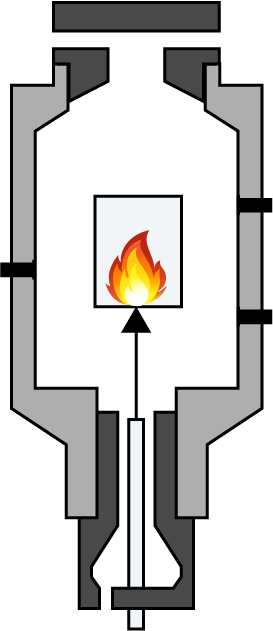
The FID is the most widely used GC detector. A hydrogen and air flame burns the column eluent as it exits, and organic compounds passing through that flame produce ions. The current generated by those ions is the signal.
FID responds to almost any compound containing carbon-hydrogen bonds. That makes it well suited to general organic analysis: hydrocarbons, solvents, alcohols, fatty acids, and most organic compounds a lab is likely to encounter. It is sensitive and stable.
Its limitation is the same as its strength: it is non-selective. In a complex sample, everything with a C-H bond produces a signal. Separating your target from everything else depends on the GC column and the method, not the detector.
FID is a good choice when samples are reasonably clean, or when the GC separation itself can isolate the compound of interest. It is commonly used in alcohol analysis, hydrocarbon gas analysis, and residual solvent work.
FID does not detect water, carbon dioxide, or other fully oxidised species. In some matrices that is an advantage, as it removes a common source of background noise.
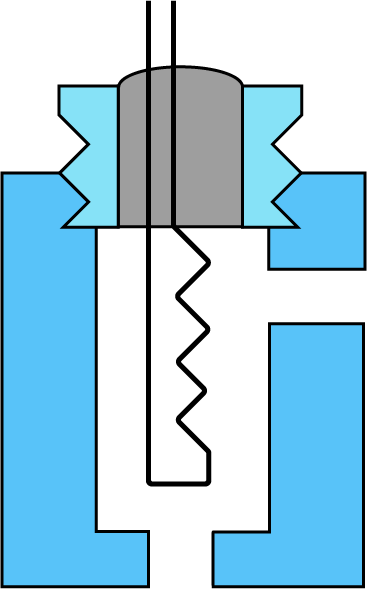
The TCD measures the difference in thermal conductivity between the carrier gas and the column eluent. When a compound elutes from the column, it changes the thermal conductivity of the gas stream passing over a heated element. That change is the signal.
Because the TCD responds to anything that conducts heat differently from the carrier gas, it is a universal detector. It will detect compounds that FID cannot, including water, carbon dioxide, and permanent gases such as hydrogen, oxygen, and nitrogen. That makes it useful in natural gas analysis and LPG composition testing, where permanent gases are part of the sample.
The trade-off is sensitivity. TCD is less sensitive than FID, and it requires the carrier gas to have a very different thermal conductivity from the compounds being detected. Helium and hydrogen are the carrier gases of choice for this reason.
For trace analysis, TCD is usually the wrong tool. For compositional work where you need to account for everything in the sample, including gases that FID would miss, it is often the only option.
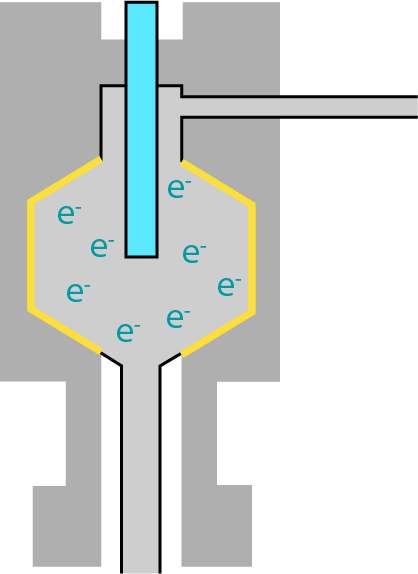
The ECD contains a radioactive source, typically nickel-63, that emits beta particles into a stream of carrier gas and produces a steady background current of electrons. When compounds with high electron affinity pass through, they capture those electrons and reduce the current. That reduction is the signal.
The ECD is sensitive to compounds that capture electrons readily: halogenated compounds, conjugated carbonyls, and certain pesticides. For these compound classes, it offers high sensitivity and more selectivity than FID.
That selectivity is useful in pesticide analysis in cannabis and environmental monitoring, where halogenated compounds are the target and the matrix is complex.
The nickel-63 source is a regulated radioactive material. Handling, transportation, and disposal must comply with local radiation regulations. Ellutia offers an ECD wipe test kit and a compliant disposal service for labs managing end-of-life instruments.
GC-MS combines gas chromatography with mass spectrometry. As compounds elute from the column, they are ionised and the resulting fragments are measured by mass-to-charge ratio. Every compound produces a characteristic mass spectrum, and that spectrum is what the instrument uses to identify it.
Where other detectors tell you something is there, GC-MS can tell you what it is. That makes it the standard tool for unknown compound identification, regulatory confirmation work, and method development where you need structural evidence.
The trade-offs are worth understanding. GC-MS is more complex and expensive to run than a selective detector, and the two operating modes each come with limitations. Full scan mode acquires data across the full mass range and is useful for screening or unknown identification, but sensitivity is lower. Selected ion monitoring (SIM) mode improves sensitivity by targeting specific ions, but it only detects what it has been set up to find. If a compound is present that is not in your ion list, you will not see it.
In complex matrices, fragment ions from other compounds in the sample can also overlap with those of the target, increasing the risk of false positives. This is particularly relevant in pharmaceutical nitrosamine testing, where trace-level accuracy is critical. Most labs manage this by pairing GC-MS with a selective detector: using the selective detector for routine screening and bringing GC-MS in for confirmation when a positive result needs identifying.
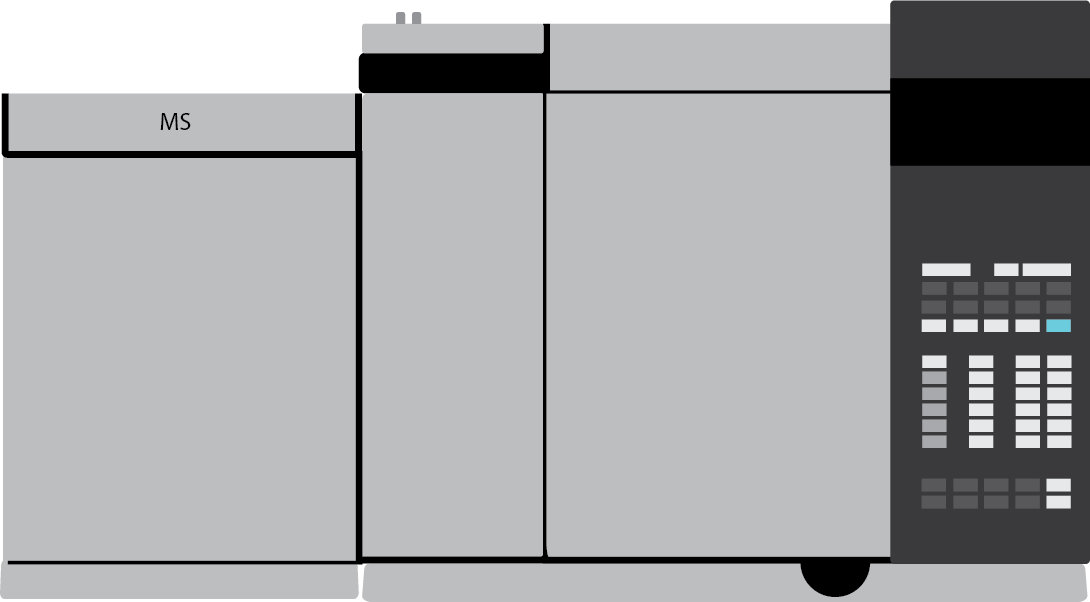
The TEA responds to a single structural feature: the N-NO bond present in every nitrosamine.
Compounds eluting from the column pass through a pyrolyser, where heat cleaves the N-NO bond and releases nitric oxide. That nitric oxide reacts with ozone in the detector to produce a chemiluminescent signal. Compounds without a nitroso group do not produce the same response.
In complex pharmaceutical, food, or cosmetic matrices, nitrosamines must be detected at very low concentrations alongside a large amount of other chemistry. The TEA produces a clean chromatogram in these conditions because most of the background does not respond. A nitrosamine at low concentration does not have to compete with everything else in the sample.
Beyond nitrosamines, the TEA is also used for nitroso and nitro compounds, including explosive residue analysis in defence and security applications.
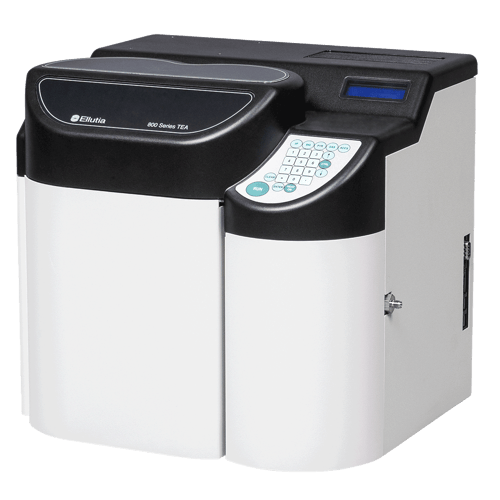
The TEA is the standard detector for nitrosamine analysis across pharmaceuticals, cosmetics, food, and rubber. Regulatory frameworks including EMA guidance on nitrosamine impurities and ICH M7(R2) set acceptable intake limits for compounds such as NDMA at 96 ng/day. At those concentrations, detection requires both high sensitivity and compound-class selectivity. It is often used alongside GC-MS: the TEA for routine screening, GC-MS for confirmation when a positive result needs identifying. Ellutia's 800 Series TEA couples directly to a gas chromatograph. It is also the detection core of the Automated Total Nitrosamine Analyser (ATNA).