
Skip to the main content.

4 min read

Which Detector for Nitrosamine Analysis? A Comparison of GC-MS, NPD, and the TEA

Not every detector is right for every analysis, and in trace nitrosamine work the consequences of a wrong choice are significant. The compounds are regulated at very low concentrations and the sample matrices are often complex. The detector you choose determines how well your method handles both. Get the sensitivity wrong and you miss the compound. Get the selectivity wrong and the matrix buries it.

GC-MS, NPD, and the thermal energy analyser are the three detectors that come up most in this space. Each one takes a different approach, and each one has a different set of trade-offs.

If you prefer to watch rather than read, we cover the same topic in the video below.

Why detector choice matters

Nitrosamines like NDMA, NDEA, and NDELA are regulated across pharmaceuticals, cosmetics, and food, with limits that are down in the low parts per billion. You are not looking for these compounds in a clean solvent either. You are looking for them inside a pharmaceutical tablet, a cosmetic cream, or a rubber extract, and those matrices bring a lot of other chemistry with them.

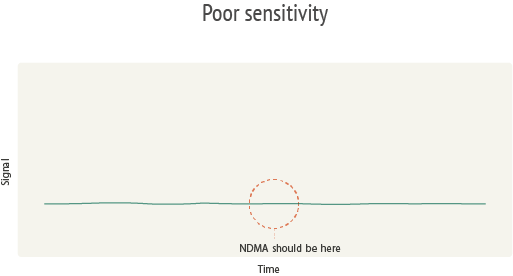
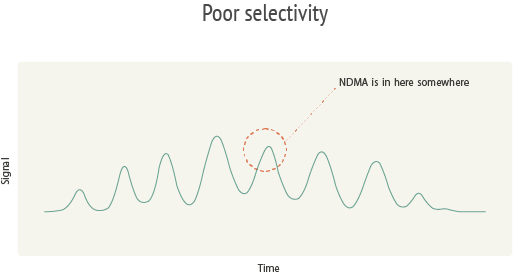
That creates two distinct ways an analysis can fail. If your detector lacks the sensitivity to see your target compound at the concentration you need to test to, the peak simply does not appear. If it lacks the selectivity to pick your compound out clearly from everything else in the sample, the matrix buries it. Either way, the result is wrong.

The detector you choose determines which of those problems you have, and how difficult they are to manage.

Poor_Sensitivity
Poor_Selectivity

The strengths and limits of GC-MS

GC-MS identifies compounds by ionising them as they elute from the column and measuring the mass-to-charge ratio of the resulting fragments. Every compound produces a characteristic mass spectrum, and that is what the instrument uses to identify it. For confirmation work, it is difficult to beat. If you need to know that what you have found is NDMA and not something with a similar retention time, GC-MS is where you go.

The challenge is that in complex matrices, GC-MS responds to a wide range of compounds. In pharmaceutical samples in particular, compounds involved in nitrosamine formation pathways can produce fragment ions that overlap with the target nitrosamines, which increases the risk of false positives.

Most analysts address this by running in selected ion monitoring mode, or SIM mode. Rather than scanning the full mass range, the instrument monitors only the specific ions you have told it to look for. That improves both sensitivity and selectivity for targeted analysis. The trade-off is that SIM mode only finds what it has been set up to find. If a nitrosamine is present that you have not included in your ion list, you will not see it.

For confirmation of a known compound, that is a reasonable trade-off. For screening work, or samples where the full nitrosamine profile is unknown, it becomes a much bigger problem.

The strengths and limits of NPD

The nitrogen-phosphorus detector responds selectively to compounds containing nitrogen and phosphorus. Compared to a flame ionisation detector, which responds to virtually anything organic, NPD produces a cleaner chromatogram in samples where most of the background matrix does not contain nitrogen or phosphorus.

The limitation is that nitrogen-containing compounds are common in most of the sample types where nitrosamine analysis matters. In pharmaceutical matrices, amines, amides, and other nitrogen-containing compounds sit alongside the nitrosamines themselves, and NPD responds to all of them. Its selectivity is for nitrogen, not for nitrosamines specifically.

NPD has a place in applications where sample matrices are simpler and some additional selectivity over FID is useful. For trace nitrosamine analysis in complex matrices, those limitations show up quickly.

The strengths and limits of the TEA

The thermal energy analyser works on a different principle to the other two detectors. Rather than characterising the whole molecule or responding to a class of element, it responds to a single structural feature: the N-NO bond present in every nitrosamine.

Before a compound containing a nitroso group reaches the detector, it passes through a pyrolyser, where heat cleaves the bond and releases nitric oxide. That nitric oxide reacts with ozone to produce a light-emitting, chemiluminescent signal, which the detector measures. Compounds without a nitroso group do not produce the same response.

The result is a detector that is selective at the chemical level. Background compounds from a complex sample matrix do not generate the same signal, so the chromatogram is clean and the peaks that do appear are the ones worth looking at. A nitrosamine present at low concentration does not have to compete with interference from everything else in the sample.

Why many labs use GC-MS and the TEA together

GC-MS and the TEA address different parts of the same problem, which is why many labs doing this type of analysis use both.

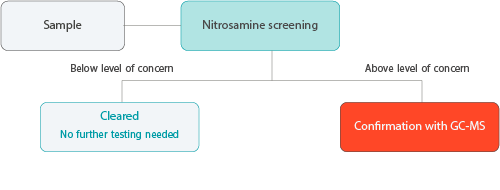
The TEA handles routine screening. When you are running a batch of samples and need to know if nitrosamines are present above a threshold, the clean chromatogram and low background make that a quick, clear call. When a result comes back positive, the question shifts from the presence of nitrosamines to which ones, and at what level. GC-MS answers that. The mass spectrum gives you the identification and confirmation that a selective detector alone cannot provide.

The workflow becomes: screen with the TEA, confirm with GC-MS. Each instrument does what it does best.


Nitrosamine_Screening

Matching the detector to the analysis

Choosing the right detector for any given application comes down to what the lab is actually trying to answer.

If the question is if a specific compound is present and what it is, GC-MS is the natural starting point. It provides the structural information and confirmation that no other detector can match. For regulatory submissions, for investigating an unknown peak, or for building a validated method on a new compound, that identification capability is what matters.

If the question is a clean result at the level you need to test to, the TEA is where to start. Its selectivity for the nitroso group removes most of the background complexity that makes trace analysis difficult in complex matrices.

NPD sits between the two. It is a reasonable choice where matrices are simpler and a degree of additional selectivity over FID is needed, but it does not offer the compound-specific identification of GC-MS or the nitrosamine-specific selectivity of the TEA.

For most labs analysing nitrosamines, the answer is GC-TEA for routine analysis, with GC-MS available for identification and confirmation when a positive result needs following up.

GC-MS NPD TEA
Selectivity
Broad, managed via SIM mode
Nitrogen and phosphorus compounds
Nitroso group specifically
Identification
Full structural confirmation via mass spectrum
Retention time
Retention time - coupled to GC
Best for
Confirmation of known compounds
Simpler matrices, moderate selectivity needs
Routine screening in complex matrices
Limitation
• False positive risk in complex matrices.
• SIM mode will not detect unexpected or unknown nitrosamines
Is not selective for nitrosamines specifically.
Not currently accepted as a confirmatory method for regulatory submissions

Nitrosamine-selective detection with the 800 Series TEA

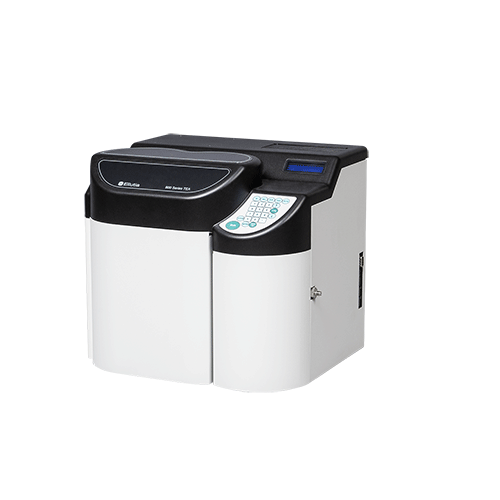
The 800 Series TEA is Ellutia's thermal energy analyser for nitrosamine detection. It responds to the N-NO bond present in every nitrosamine, giving it the compound-class selectivity that makes it well suited to trace analysis in complex matrices.

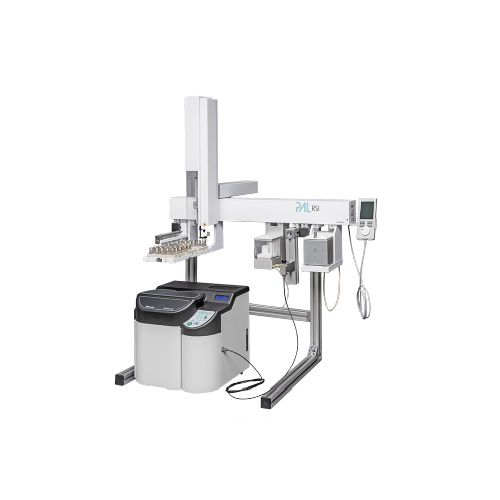
The TEA couples directly to a gas chromatograph for GC-TEA analysis, and also forms the detection core of the ATNA system for labs running total nitrosamine screening. Both configurations use the same detection principle.

Ellutia TEA Thermal Energy Analyser-4

800 Series TEA

For labs adding nitrosamine-selective detection to an existing GC setup.

ATNA_Automated_Nitrosamine_Analyser

ATNA: Automated Total Nitrosamine Analyser

For labs running total nitrosamine screening with automated sample handling and overnight batch capability.