Skip to the main content.

3 min read

How Do You Know If a GC System Is Right for LPG Testing?

If you're responsible for LPG quality at a terminal, storage facility or distribution depot, there's a good chance you've asked some version of this question.

Maybe you're sending samples to an external lab and wondering whether in-house testing makes more sense. Maybe someone in the business has floated the idea of buying a gas chromatograph and you've been asked to look into it. Or maybe you already have a GC and you're not entirely confident it's set up correctly for LPG work.

The uncertainty tends to be the same regardless. You know composition testing matters, LPG is bought and sold on it, but the instrument side of things can be hard to get a clear picture of if you haven't been through it before.


Why composition matters more than most people realise

LPG isn't a single product. It's a mixture, primarily propane and butane, with varying amounts of propene, isobutane, butenes and pentanes depending on the source and how it's been processed.

Those proportions have real consequences. They determine vapour pressure, energy content, cold-weather performance and whether the product meets the contractual specification it was bought under.

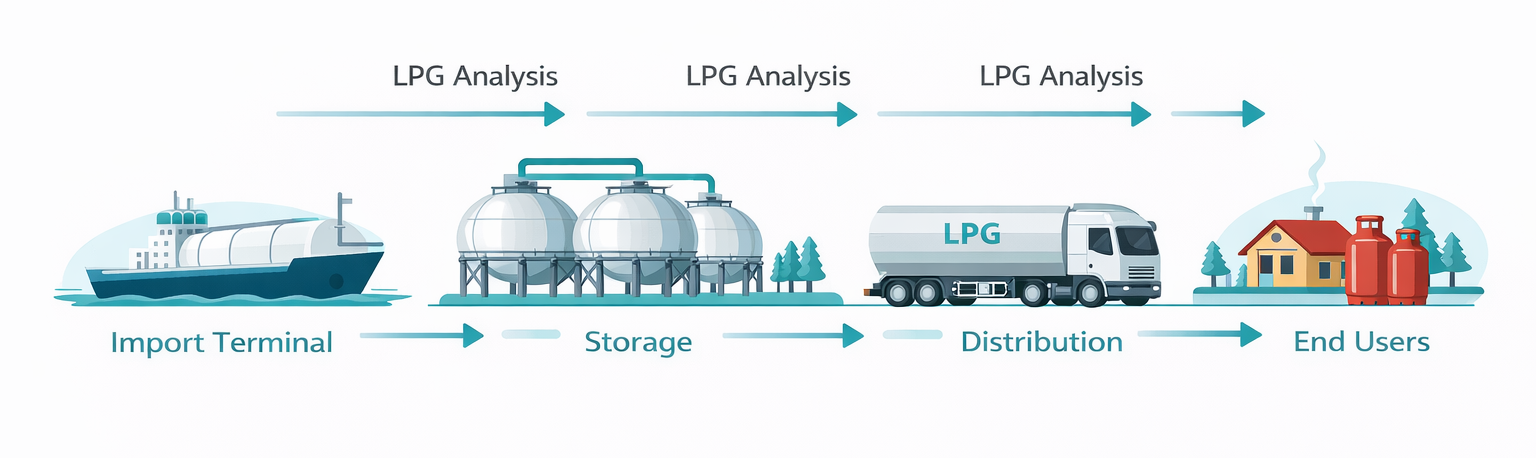
When cargo arrives at an import terminal, nobody takes the supplier's word for it. The product is tested. The composition is checked against what was agreed. If something doesn't match, heavier hydrocarbons where there shouldn't be any, or a propane/butane ratio that's off, that's a problem worth finding before you've offloaded thousands of tonnes of it.

The same logic applies further down the chain. Blending facilities adjust propane-to-butane ratios for seasonal products. Distribution depots confirm composition before filling tankers. At every one of those points, someone needs a reliable number. Gas chromatography is the method that generates it.

LPG_Supply_Chain_01

If you're evaluating GC testing for LPG, our buyers guide covers everything from sampling approaches to system configuration.


What gas chromatography actually does

A gas chromatograph separates the individual hydrocarbons in a sample so each one can be measured on its own.

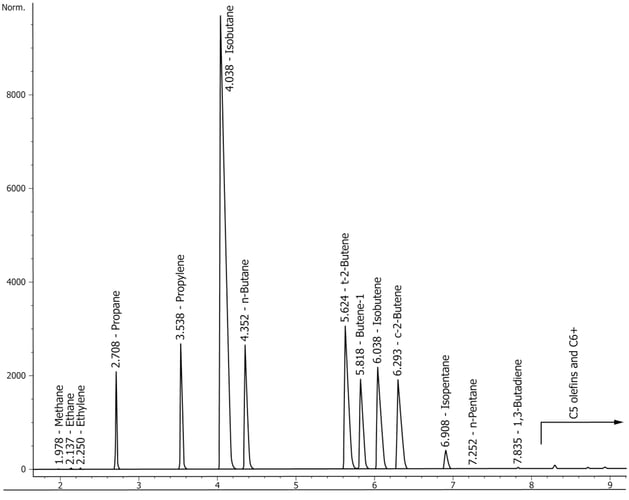
The results come back as a chromatogram, a series of peaks, each corresponding to a specific component.


LPG_Chromatogran


Propane at one retention time, isobutane at another, then n-butane, propene, pentanes. The area of each peak tells you how much of that component is present.

From there, the compositional data can be used to verify specification compliance against standards like ASTM D1835 or EN 589, calculate physical properties like vapour pressure and density (ASTM D2598 covers the method for this), and convert results between reporting bases, gas volume percent, liquid volume percent, mass percent, when contracts or regulatory requirements call for it.

The analytical methods for LPG, most commonly ASTM D2163, are well established. What varies is how you configure the system for your specific situation, and that's where the real decisions sit.


The questions that actually matter when you're evaluating

The confusion around buying a GC for LPG testing rarely comes down to whether GC is the right technique. It is, and has been for decades. The confusion tends to sit around the practical stuff.


How will the LPG sample get into the instrument?


LPG is stored as a pressurised liquid. Getting it into a GC without losing the lighter components requires some thought. There are two main approaches, liquid sampling and vapour sampling, and the right one depends on your facility setup and existing hardware.
Can it actually resolve every component?


Yes, but the column and detector need to be set up correctly for LPG. A well-configured system will separate propane, the butane isomers, butenes and pentanes in a single run. The components are there — it's the configuration that determines whether you can see them all clearly.

How does analysis time affect your operation?


It depends on what you're running. A terminal turning around cargo checks needs results quickly and reliably, one after another. A depot testing a handful of samples a week has more flexibility. A typical LPG GC run is designed to balance separation quality with practical throughput, but it's worth knowing where your operation sits before you configure the system.

What does running it day-to-day actually look like?


More straightforward than most people expect. Calibration practices, results reporting, property calculations downstream — these all need to be accounted for. The instrument needs to slot into what already exists, not create a parallel process that quietly gets ignored after six months.

These aren't difficult questions to answer. They do need to be worked through before you commit to a configuration.


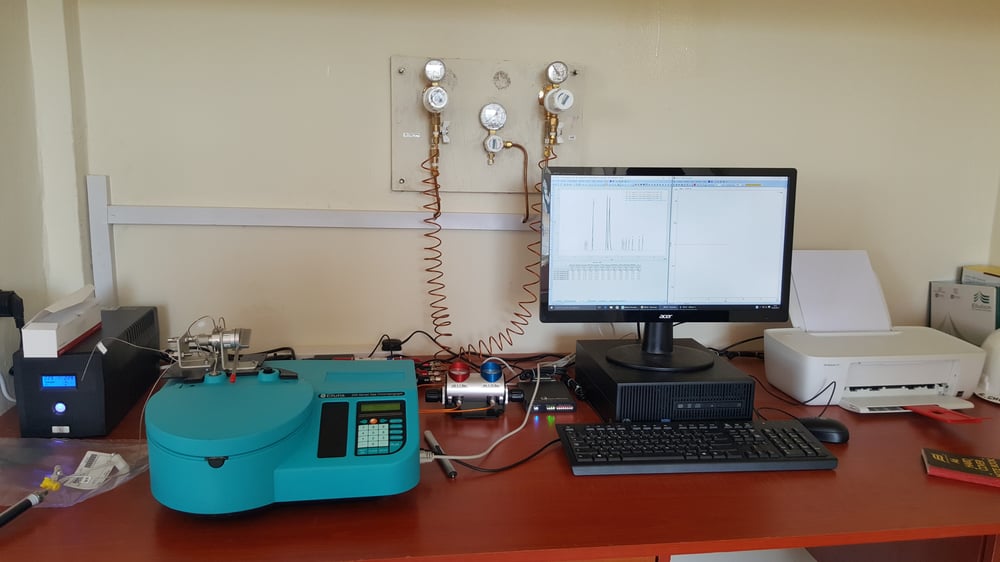
LPG Analyser at AGOL

A starting point

If you're at the early stages of evaluating LPG GC testing, whether for a new installation, an upgrade, or just getting a clearer picture of what's involved, we've put together a practical buyers guide.

It covers the standards used in LPG testing, the hydrocarbons typically measured, how the two sampling approaches compare, the key components of a GC system for LPG, and what to think about when choosing a configuration for your laboratory. If you're trying to make a confident decision rather than just a purchase, it's worth a read before you commit to anything.


What equipment makes up a Permeation Testing System?

What equipment makes up a Permeation Testing System?

Hello, and welcome to our first blog in a series on permeation analysis. Permeation systems play an essential role in testing various materials for...

Read More
Building an Educational GC: Designing for the Future!

Building an Educational GC: Designing for the Future!

We found numerous challenges universities and educational institutions face with their GC systems. After many conversations, we learned that some of...

Read More
The Tools You Need to Detect Nitrosamines in Cannabis & Hemp

The Tools You Need to Detect Nitrosamines in Cannabis & Hemp

Nitrosamines are among the most tightly regulated contaminants in pharmaceuticals, food, and tobacco, yet in cannabis, they are barely on the...

Read More