The split ratio is one of the first things you set when building a GC method, and one of the easiest to get wrong without realising it. It controls how much of your vaporised sample enters the column and how much is vented. Set it too high and you lose sensitivity. Set it too low and the column overloads.
If you prefer to watch rather than read, we cover the same topic in the video below.
What the split ratio controls
In split injection, the sample is vaporised in the heated inlet and only a fraction of the vapour enters the column. The rest is vented. The split ratio is the ratio between the vented portion and the portion that reaches the column.
A split ratio of 50:1 means that for every 51 parts of vaporised sample, 1 part enters the column and 50 parts are vented. Higher ratios send less sample to the column. Lower ratios send more.
The ratio is set by controlling the carrier gas flow and the split vent flow. The instrument calculates and maintains it based on the flows you set. That means the accuracy of your split ratio depends entirely on the accuracy of your gas flow.
How to choose a split ratio based on your sample
There is no single correct split ratio. The right setting depends on the sample concentration, the column capacity, and the sensitivity of your detector.
For concentrated samples with components at percent level, ratios of 100:1 to 200:1 are common. This keeps the amount of sample reaching the column well within its capacity and produces sharp, well-resolved peaks.
For mid-range samples at ppm level, ratios of 20:1 to 50:1 are typical. This balances column loading against the need for enough signal at the detector.
For trace-level work, low split ratios of 5:1 to 10:1 send more sample to the column to improve detection. Below that, splitless injection is often the better option because it sends the entire vaporised sample onto the column rather than diverting any of it.
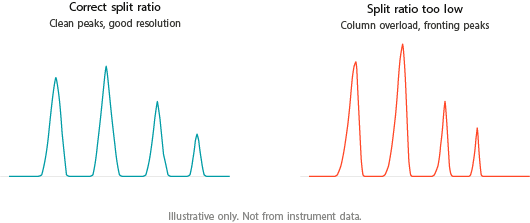
A good starting point is a mid-range ratio. Adjust based on what you see: if peaks are fronting or distorted, increase the ratio. If sensitivity is too low, decrease it.
Sample concentration
Typical split ratio
Percent level
100:1 to 200:1
ppm level
20:1 to 50:1
Trace level
5:1 to 10:1
Very low / trace
Splitless
What wrong looks like
When the split ratio is off, the chromatogram usually tells you. The trick is knowing what to look for.
If the ratio is too low for your sample concentration, the column receives more sample than it can handle. Peaks start to front, with a sharp rise on the leading edge and a gradual tail on the other side. In more serious cases the peak shape distorts completely and resolution between neighbouring peaks breaks down. This is column overload, and the fix is to increase the split ratio or dilute the sample.
If the ratio is too high, less sample reaches the column and the signal at the detector drops. Peaks get smaller. At some point they fall below the limit of detection and you lose the compound entirely. If your sensitivity is too low and you are confident the compound is present, reducing the split ratio sends more sample to the column. If that still is not enough, switching to splitless injection may be the next step.
If peak shapes vary between runs but nothing else in the method has changed, the problem may not be the ratio you set. It may be the ratio you are actually getting. Gas flow can drift over time, and when it does, the effective split ratio shifts with it. The instrument will still report what you programmed, not what is happening at the inlet.
Why the ratio you set might not be the ratio you're getting
The split ratio depends on accurate gas flow. The instrument calculates it from the carrier gas flow and the split vent flow, and reports it based on what you programmed. But if the actual flow has drifted from the set value, the effective split ratio will be different from what the instrument displays.
This can happen for a number of reasons. Gas supply pressure changes, column changes, septum or liner replacements, and general wear on flow controllers can all shift the actual flow without triggering an error. The instrument does not know the flow has changed. It continues to report the values you set.
The result is a method that looks correct on screen but is not performing the way you expect. Peak shapes change, sensitivity shifts, or results vary between runs, and there is no obvious indication that the flow is the cause.
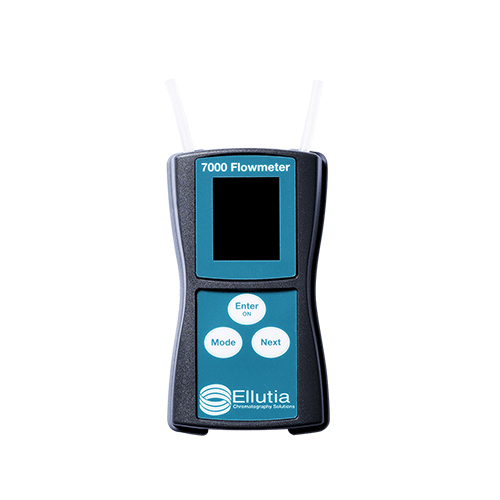
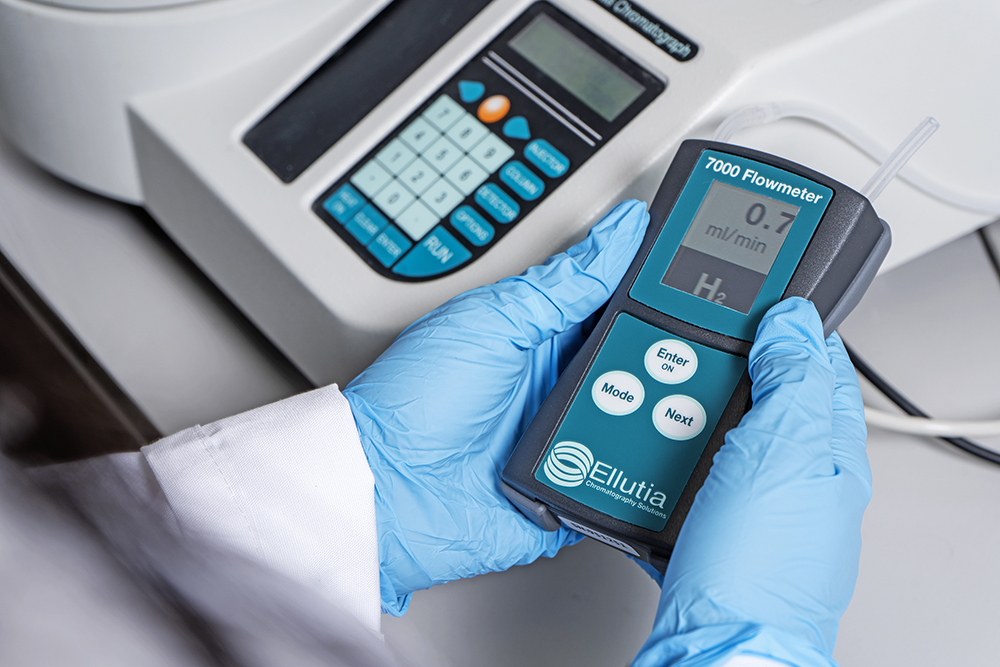
Periodic flow verification catches this before it affects your results. Using a flowmeter, like the Ellutia 7000 GC Flowmeter, to measure the actual split ratio independently of what the instrument reports tells you if the ratio you set is the ratio you are getting. It is particularly worth doing after a column change, a gas supply change, or any inlet maintenance.
Stay ahead of split ratio problems
The split ratio is a small setting with a long reach. It affects peak shape, sensitivity, resolution, and reproducibility, and when it drifts without anyone noticing, it can quietly undermine results that look fine on screen.
The good news is that it is one of the more manageable variables in a GC method. Choose a ratio based on your sample concentration. Watch your chromatograms for the signs of overload or lost sensitivity. And verify your actual flow periodically, especially after maintenance or column changes.
Most split ratio problems are not difficult to fix. They are difficult to spot.
Frequently Asked Questions
What split ratio should I use for trace analysis?
For trace-level work, split ratios of 5:1 to 10:1 are typical. Below that, splitless injection may be more appropriate because it sends the entire sample onto the column.
What causes fronting peaks in GC?
Fronting peaks are usually caused by column overload. The most common fix is to increase the split ratio or dilute the sample.
How do I check my actual split ratio?
Measure the column flow and split flow independently using a flowmeter. Compare the measured ratio against what the instrument reports.
When should I use splitless injection instead of split?
When your analyte is at very low concentration and you need maximum sensitivity. Splitless injection sends the entire vaporised sample onto the column.
7000 GC Flowmeter
The Ellutia 7000 GC Flowmeter measures eight common GC gases with UKAS-traceable accuracy (calibrated to UK national measurement standards). In split flow mode, it measures the column flow and split flow separately and displays the actual split ratio, so you can compare it against what the instrument reports without doing the calculation yourself.